Cite
Cassi, Roberta, Masashi Kajita, and Olga Popovic Larsen. “User-Environment Interaction: The Usability Model for Universal Design Assessment.” In Universal Design 2021: From Special to Mainstream Solutions, edited by Ira Verma, Vol. 282. Studies in Health Technology and Informatics. IOS Press, 2021. https://doi.org/10.3233/SHTI210385.
Jeremy
Synth
Md
FirstEditor:: Verma, Ira
~> FirstAuthor:: Cassi, Roberta
Author:: Kajita, Masashi
Author:: Popovic Larsen, Olga
~
Title:: User-Environment Interaction: The Usability Model for Universal Design Assessment
Year:: 2021
Citekey:: cassiUserEnvironmentInteractionUsability2021
itemType:: bookSection
Volume:: 282
Book::
Publisher:: IOS Press
ISBN:: 978-1-64368-190-0 978-1-64368-191-7
LINK
Abstract
Universal Design (UD) aims to provide designed environments that allow users to fully participate in all kinds of activities. Especially, the design of Sport and Leisure buildings should support and encourage the participation of mobility and sensory impaired people in any physical and social activity. Yet, the variety of physical and social users’ needs calls for different approaches to investigate, analyze and assess how the environment fulfills users’ needs and expectations. This paper presents a new analytical model that: a) investigates how people with mobility, visual, and hearing impairments interact with specific architectural features; b) links the examined user-environment interaction with the user’s personal assessment of the spatial experience. The study employs the literature review of the existing analytical models, which are based on the concept of user-environment interaction and framed around empirically deducted basic human needs. These models address the issue of user-environment fit by focusing on the identification of environmental barriers. Also, some of these models are too descriptive and cannot inform the practice in creative design processes. The proposed analytical model, which is built upon the theoretical concepts of affordances and usability, aims to develop a qualitative evaluation method for identifying environmental facilitators by linking the design of architectural characteristics with the influenced perception of users of the physical and social aspects of the built environment. The model consists of three groups of elements: (1) users’ physical abilities; (2) architectural features and (3) usability criteria. The inter-relations of each element across the groups develop the narrating scenarios that can be investigated from the user’s perspective. This new model does not only advance the understanding of the spatial experiences of persons with mobility and sensory impairments but also offers new insights for exploring UD solutions by identifying the architectural features that enlarge the spectrum of possible user-environment interactions. .
Notes
Annotations
Imported: 2024-05-09 2:37 am
Quote
It could happen that some characteristics of the environment do not fit with our physical conditions or with our personal needs. These characteristics are therefore experienced as barriers.
Pg.2
- I wonder where tallness comes into this. Airplanes is an example. The design has gotten smaller, but has excluded more people.
Quote
each person perceives, relates, and experiences the environment differently, due to diverse individual physical and sensory characteristics. A child, an old lady, or a blind person can have a different experience of the same hallway. A child, who experiences the hallway from a lower point of view, might have a reduced visual connection to the surrounding environment. An old lady may probably pay attention to the presence of handrails or seats along the way. A blind person may struggle to find the right way towards the desired destination.
Pg.2
*
Quote
Despite the undoubted importance for people with disabilities to engage in physical activity, most sports and leisure buildings, even if they are considered accessible, do not necessarily influence disabled users ́ spatial experiences positively.
Pg.2
*
Quote
Within UD approach, a built environment is accessible when it is usable by any person with any temporary or permanent impairment [3]. When the demand for performing activities in the environment exceeds the abilities of the person, the environment, which is not responsive to the individual’s needs, is experienced as a barrier [4]. The interaction between a person with impairments and environmental barriers results in a condition of disability and thus in reduced participation in society [5].
Pg.3
- If a person can’t use something because of an impairment, then that object becomes a disabling object.
Quote
In particular, UD does not focus only on creating accessible environments for people with disabilities, but it aims to create physical and social inclusion for the entire population, recognizing diversity as an added value to be considered and included in the design process.
Pg.4
*
Quote
The Person-Environment-Occupation model describes the relationship between the person, the occupation, and the environment for further unfolding environment-behavior theories and supporting practical guidelines in occupational therapy [13]. The model is based on three elements: 1) the person, 2) the environment, and 3) the occupation.
Pg.5
*
Quote
This model acknowledges the complexity and the dynamism of the personenvironment interplay. It recognizes the changes caused by different personal circumstances and contexts, and therefore requires continuous monitoring to better determine the possible interventions in the built environment [13]. The PersonEnvironment-Occupation model clearly expresses the condition of disability by representing it as a mismatch of the three main components.
Pg.6
*
Quote
The Housing Enabler model [14, 15, 16] is a tool for a more objective assessment of physical barriers and housing accessibility.
Pg.6
*
Quote
The Users-Built Environments model [17] aims to map, document, and resolve conflicts between users and built environments by relating permanent, temporary, and situational limitations of the user with environmental features during the performance of observed activities. The model is framed around two main components: 1) the user and 2) the environment.
Pg.8
*
Quote
Although this model is very useful for improving the knowledge of the dynamics happening between the individual and the environment, it aims at identifying the disabling mechanisms, and not the enabling ones, which the proposed model intends to investigate.
Pg.9
*
Quote
The new analytical model also aims to investigate the influences of the built environment on user performance and participation. However, unlike the existing models presented above, the new one focuses on identifying the features that contribute to improving the fit between the offered spaces and the users with mobility and sensory impairments. This proposed new model is built upon the concepts of affordances and usability.
Pg.9
*
Quote
In 1977, in his article The theory of affordances, James Jerome Gibson introduced and defined affordances as the qualities of an object or an environment that suggest and allow an individual to perform an action. The term affordances refers to all the environmental features that offer users with certain skills the opportunity to act within that environment [19, 20].
Pg.9
*
Quote
ffordances have a strict relation with users and with their physical and cognitive abilities to perceive and make use of the support offered by the environment. Features that are functional to an activity for a user may not be functional in the same way for another user with different characteristics.
Pg.10
*
Quote
The concept of usability evaluates the extent to which the environment is usable by people and how well the characteristics of the environment match with a broad spectrum of physical and social needs. It describes how and to what extent the design of the environment enables operations, performance, and well-being from the user’s perspective [39, 40].
Pg.11
- Highlights the importance of digging deeper. The 7 principles of UD are a great starting point, but now we must learn from the users in the environments.
[39] S. Iwarsson, and A. Ståhl, 2003. Accessibility, usability and universal design—positioning and definition of concepts describing person-environment relationships. Disability and rehabilitation, 25(2), pp.57-66. [40] K. Alexander. 2008. Usability: philosophy and concepts. Usability of workplaces, Phase, 2.
Quote
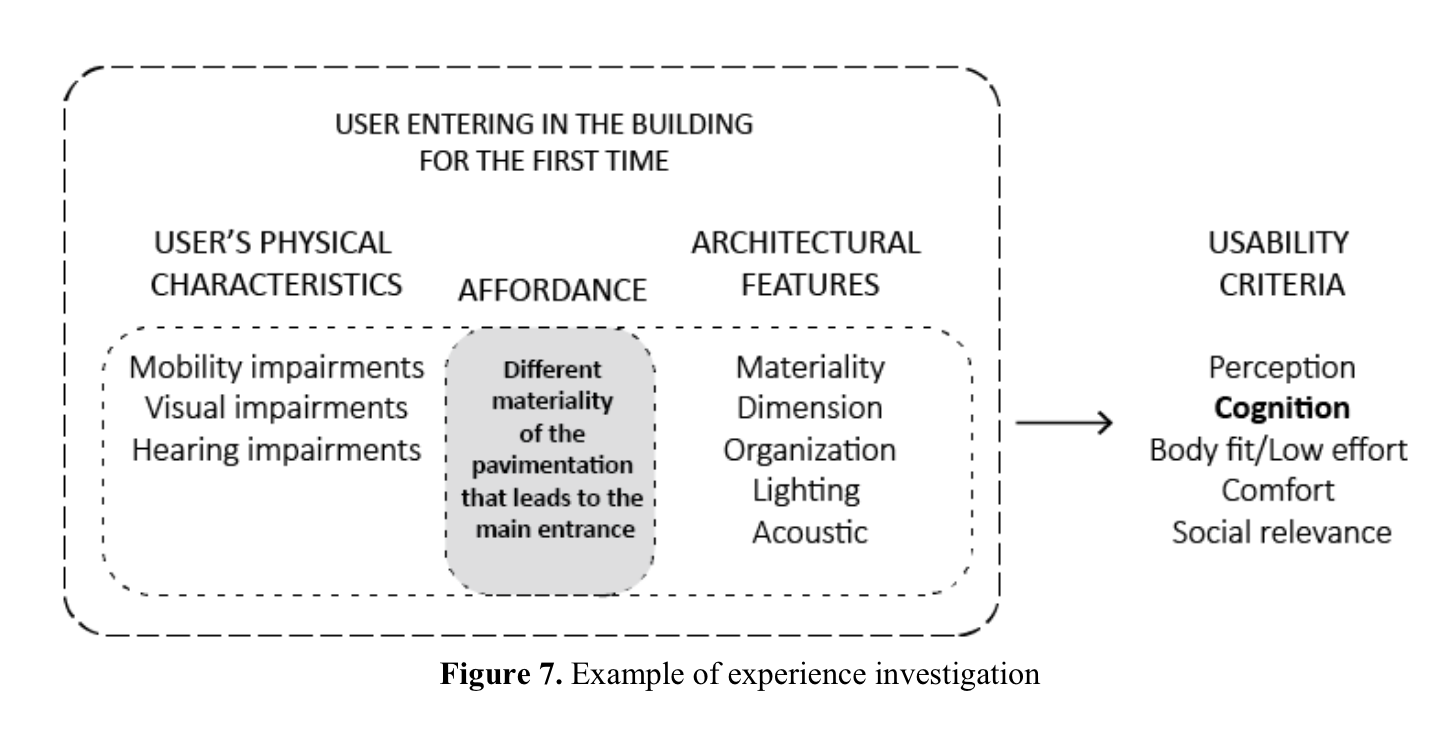
The first step is to identify, through interviews and deep observations, with which architectural features the users interact the most while they carry out the observed contextual activity. For example, when entering into the building for the first time, the materiality of the pavement, which leads the blind user towards the main entrance is considered crucial for him/her for finding the way towards the entrance. The second step, which is also carried out through interviews and direct questions to the user, is to ask about the personal assessment of how, for example, the different materiality of the pavement supports the action and affects the usability. To allow users to express their opinion on usability, the model suggests a list of criteria related to physical and social needs, which have been deductively identified from the analysis of initial interviews. Using the same example, the materiality of the pavement supports the action of entering by improving the user’s spatial cognition (Figure 7).
Pg.13
*
 cassiUserEnvironmentInteractionUsability2021-13-x107-y348.png
Pg.13
*
Quote
The investigation of different lived experiences, which are qualitatively assessed by users with impairments themselves, offers the opportunity for designers to better understand the functional requirements linked to individual necessities and preferences.
Pg.14
- Interesting this needs to be stated, but I guess it’s like a chef who never goes and talks to the guests and understands their experience.
Quote
A paradigm shift that encourages addressing spatial experiences of users with mobility and sensory impairments not as a problem-solving process, but as the possibility of experimenting with new solutions that meet the real needs of users and that encourage participation in daily activities and social life.
Pg.14
*
Quote
The model can provide architects with knowledge about user’s experiences and how these can be positively influenced by architecture. The next important step for the actual use of this model in architectural practice is the synthesis and the representation of this information into a resource that can be used by designers. This knowledge would give architects further awareness about the influences of different design solutions on users’ spatial experience.
Pg.14
- Learning is going to take time and iterations of these questions, so that every lesson learned can be put into the next building.
Quote
The environment is a crucial and influencing factor in disabling and enabling mechanisms. By better knowing which and how architectural features are able to accommodate, support, and fulfill personal needs, it can be possible to design more supportive and enhancing environments which prevent the experience of disabling mechanisms by users with mobility or sensory impairments.
Pg.14
*