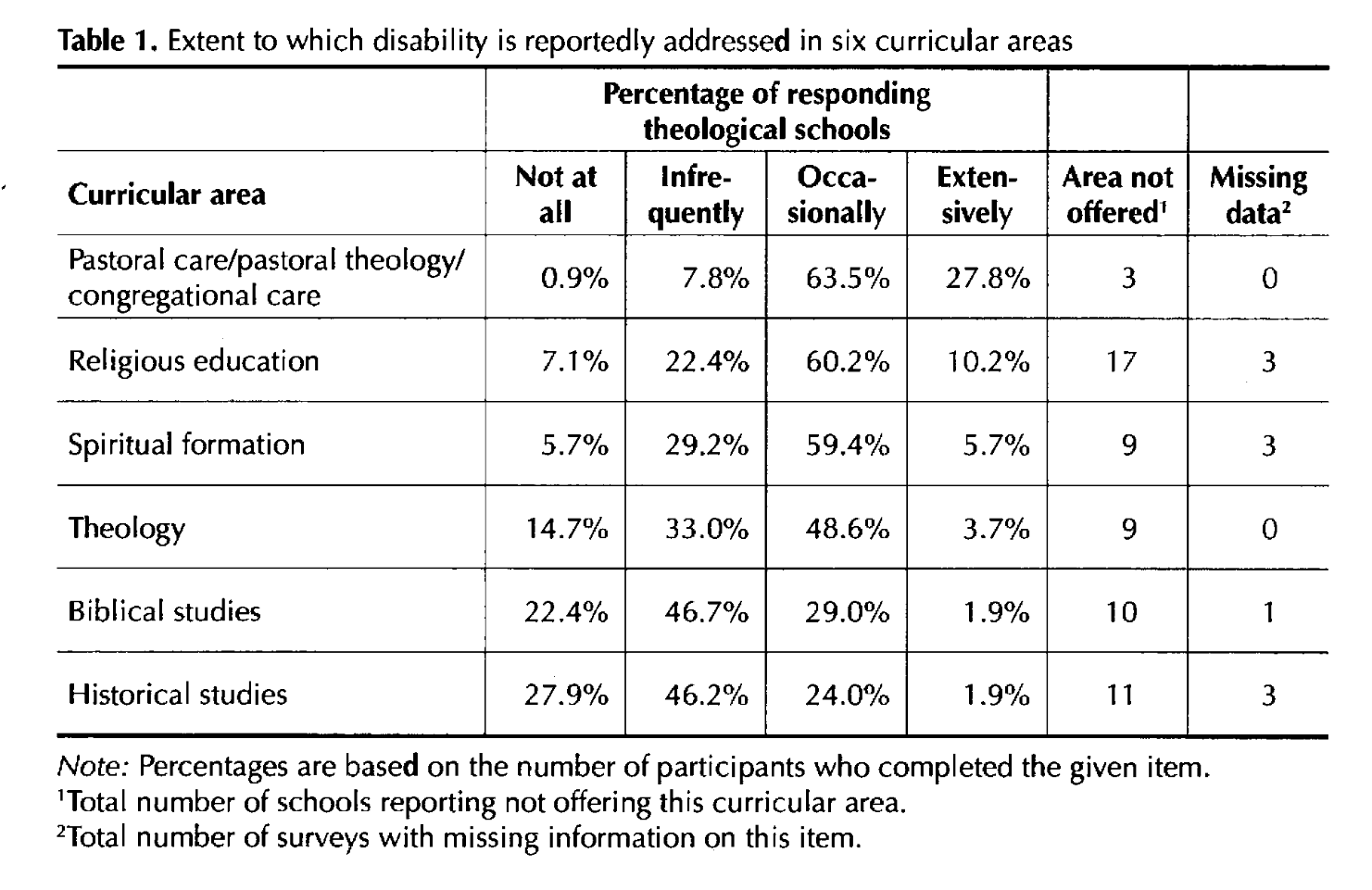
It’s not surprising that the results saw that disability was addressed most during pastoral care and education. Both of these instances would be where one would interact with a disability the most. It is the most hands on place to provide an accommodation. However it paints a disability as something to overcome and care for, as opposed to a thing that can be studied or used in understand theology.
Original Highlight:
Quote
Although most schools offered course work in all six areas, a relatively small percentage of respondents indicated that their schools addressed disability extensively within each of these curricular areas (see Table 1). When disability is addressed, it appears to be most prominent within the areas of pastoral care/pastoral theology/congregational care (occasionally or extensively addressed in 91.3 percent of schools) and religious education (occasionally or extensively addressed in 70.4 percent of schools). On the other hand, 27.9 percent of schools never addressed disability within historical studies, 22.4 percent never addressed disability within biblical studies, and 14.7 percent never addressed disability within theology.
Pg.8
Link to original note: annandalenaomihDisabilityTheologicalEducation2014 Go to annotation: