Cite
Annandale, Naomi H and Carter, Erik W. “Disability and Theological Education: A North American Study.” Theological Education 48, no. 2 (2014): 83–102.
Jeremy
Synth
Contribution::
Related::
Md
FirstAuthor:: Annandale, Naomi H
Author:: Carter, Erik W
~
Title:: Disability and theological education: a North American study
Year:: 2014
Citekey:: annandalenaomihDisabilityTheologicalEducation2014
itemType:: journalArticle
Journal:: Theological Education
Volume:: 48
Issue:: 2
Pages:: 83-102
LINK
Abstract
This article reports findings from a study examining the ways in which disability is addressed and experienced in theological schools across North America. Despite numerous calls for addressing disability in theological curricula and providing a more inclusive environment for students with disabilities, a majority oftheological educators have indicated that their graduates receive relatively limited preparation to address disabilities in ministry. Moreover, many seminary students with disabilities face challenges regarding accommodation and support on campus. This article offers recommendations for strengthening the extent to which attention to disability permeates the theological curriculum. .
Notes
Jeremy’s Review
A paper from Vanderbilt University that explores how schools with a theology department, particularly ones that are preparing clergy to lead the church, have lacked in educating regarding disabilities and what can be done about it going forward. The study surveyed college leaders (i.e. deans) and only 10.6% identified as having a disability. The results conclude that there is very little focus on disabilities in the schools surveyed and most people being prepare for ministry will be inadequately prepared to minister to those with disabilities.
Annotations
Imported: 2023-10-30 11:59 pm
See also - disabilities-are-common-to-people-in-north-america
See also - studying-disabilities-in-relation-to-theology-forces-us-to-deal-with-the-human-condition
See also - understanding-disabilities-is-a-generational-ministry-concern
See also - clergy-members-have-enormous-power-to-address-disabitlies-in-their-local-contexts
See also - clergy-members-should-have-a-well-rounded-education-regarding-disabilities
See also - clergy-education-is-way-behind-in-addressing-disabilities
See also - there-is-little-concern-for-disabilities-in-theological-education
See also - disability-education-lags-behind-women-in-ministry-and-sexuality-theology
Quote
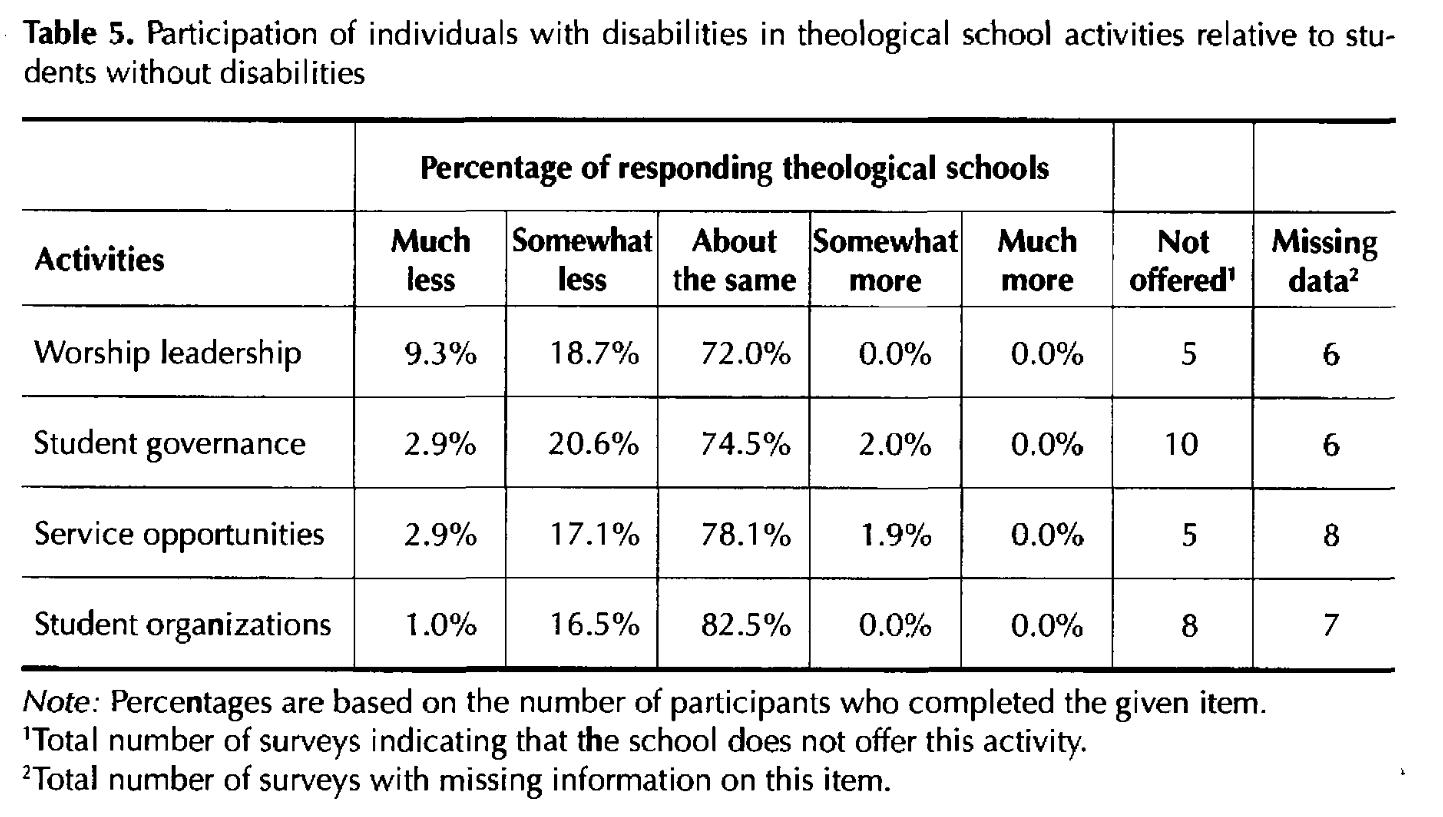
In addition to soliciting the demographic information described previously, the main sections of the survey addressed (1) where and how disability was addressed in the curriculum, (2) potential challenges to addressing disabilities within theological education, (3) the preparation of students related to including people with disabilities in future ministries, (4) interest in accessing resources related to religion and disability, (5) the involvement of people with disabilities in activities at the school, and (6) the availability of accommodations for people with disabilities at the school.
Pg.5
*
See also - pastoral-care-and-christian-education-are-the-most-likely-areas-to-address-disabilities
See also - field-work-with-people-with-disabilities-is-infrequent-or-non-existent
See also - clergy-preparation-lacks-resources-and-also-know-they-are-lacking
See also - students-with-disabilities-are-already-participating-in-most-areas-of-theological-education
See also - future-clergy-are-not-prepared-to-minister-to-people-with-disabilities
See also - disabilities-are-common-to-people-in-north-america
Quote
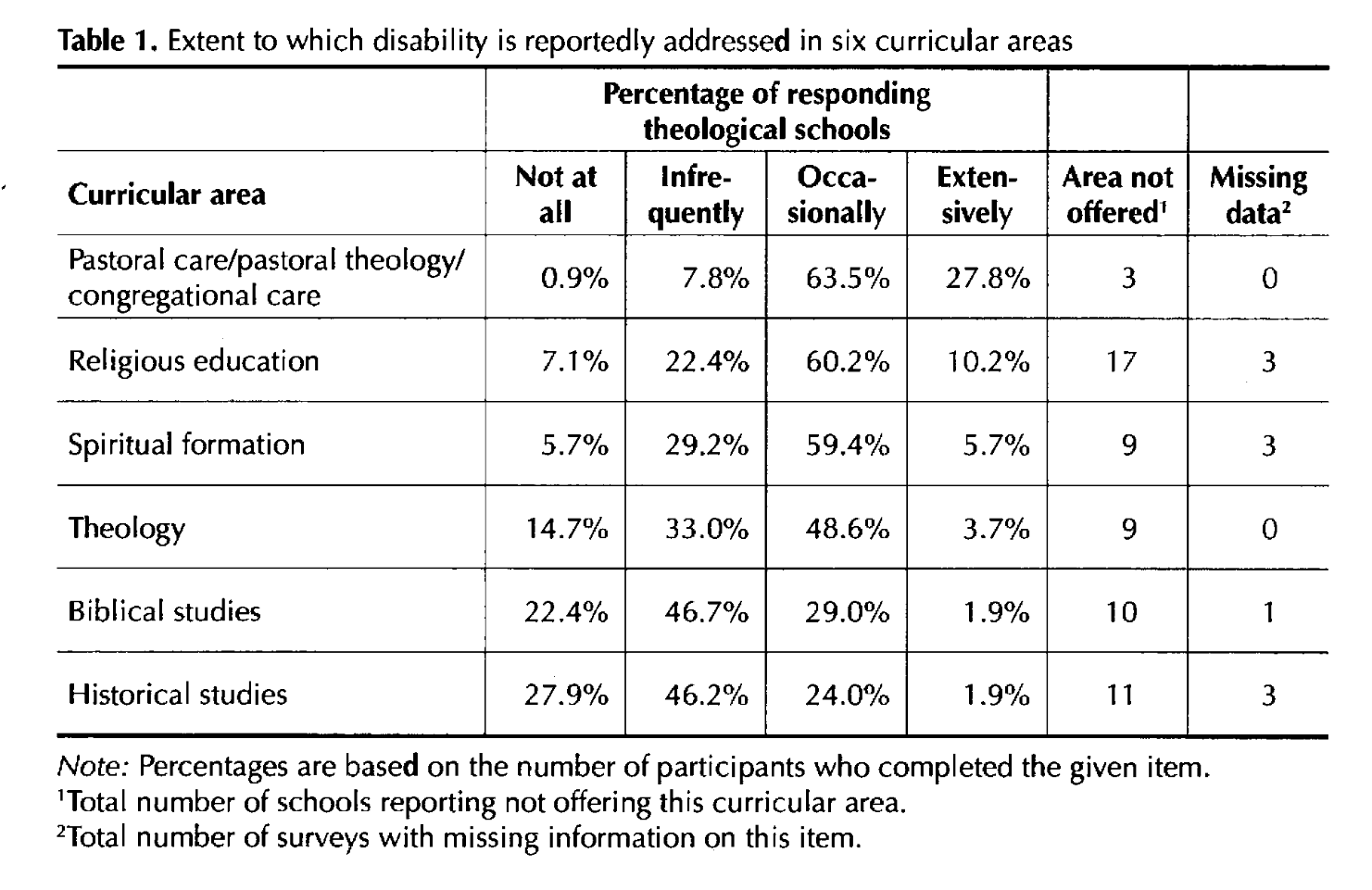
Although occasionally addressed in courses addressing pastoral care, religious education, and spiritual formation, disability was less frequently addressed in the disciplines of theology, biblical studies, and historical studies. This represents an important omission in terms of student preparation for ministry.
Pg.10
- Some of the areas of ministry preparation are at least aware of disabilities. We need to combine all aspects of ministry preparation for future clergy members.
Quote
by limiting attention to disabilities to a particular area, theological educators may be sending a subtle message that disability, an experience o£ embodied difference which in £act lifts up some 0 £ the most important questions 0 £the human condition, has little to do with the broader theological tradition. This rein£orces a long tendency in the theological fields to split the so-called practice disciplines (e.g., homiletics, pastoral care, Christian education) ftom the so-called academic disciplines.
Pg.11
- The way we address those who are different than others divides and limits what one can do or understand. The topics of the human nature can be easily discussed when disability is not something be hidden or studied to make better.
Quote
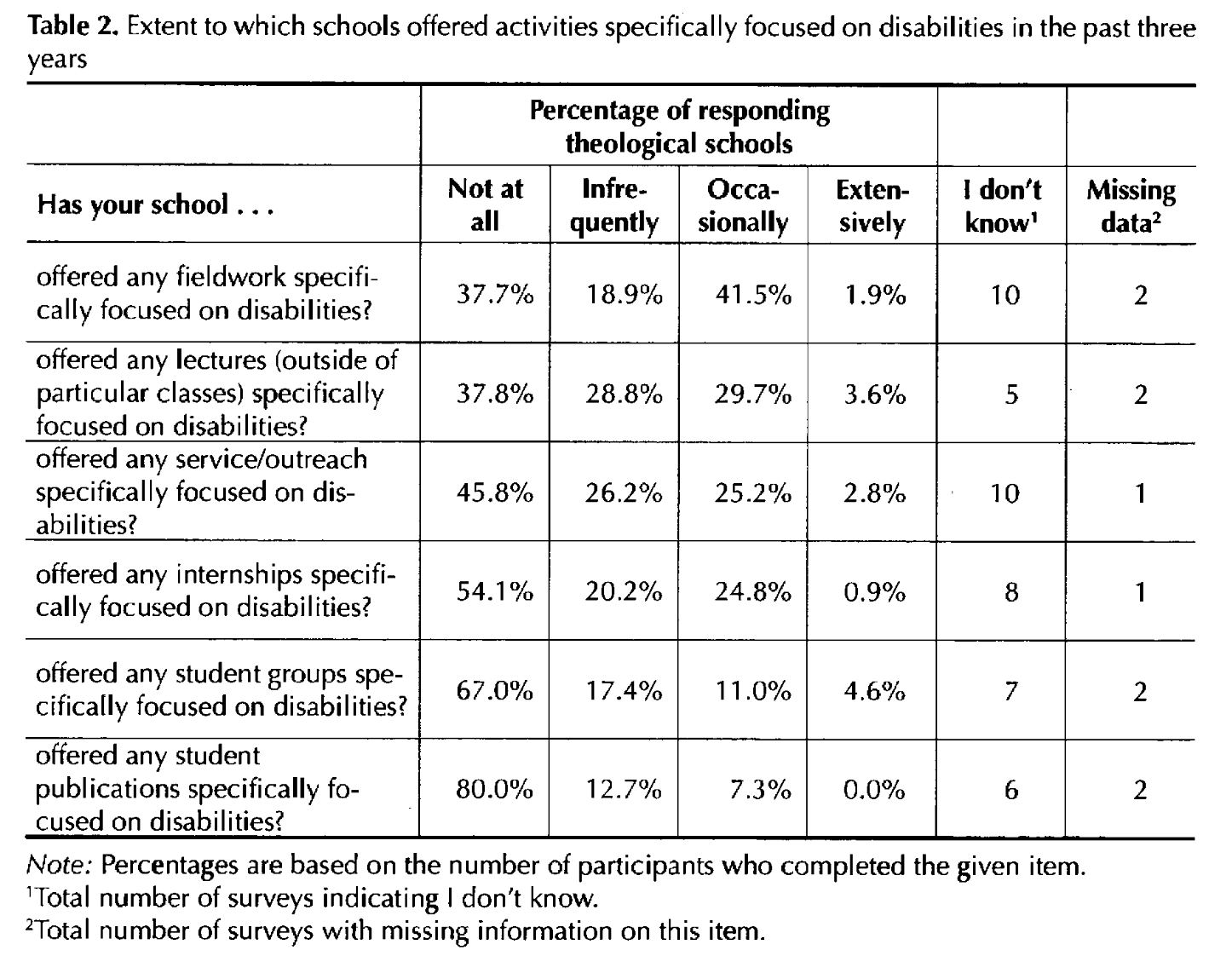
Fieldwork and internships related to disabilities were reported as being £airly limited during the prior three years, specifically, less than one quarter o£ schools offered internships £ocused on disabilities at least occasionally, while £ewer than two fifths offered fieldwork focused on disabilities at least occasionally. Lectures, service and outreach opportimities, and publications related to disabilities were £airly infrequent. Such personal encounters represent powerful opportunities £٠٢ deepening understanding o£ disabilities and ministry because they hold potential to £acilitate relationships between seminary students and persons with disabilities.
Pg.11
- The ability to have “hands on” experiences with those with disabilities through field work is almost nonexistent and even theoretical work and lectures barely exist.
Quote
As a result, many students will progress through three or more years 0 £ theological training with no exposure to the significant ministerial issues related to disability and £ew opportunities to develop a theological outlook on disability experiences and how these relate to the call 0 £faith communities.
Pg.11
- A large hole in ministry preparation is present when disabilities are ignored.
Quote
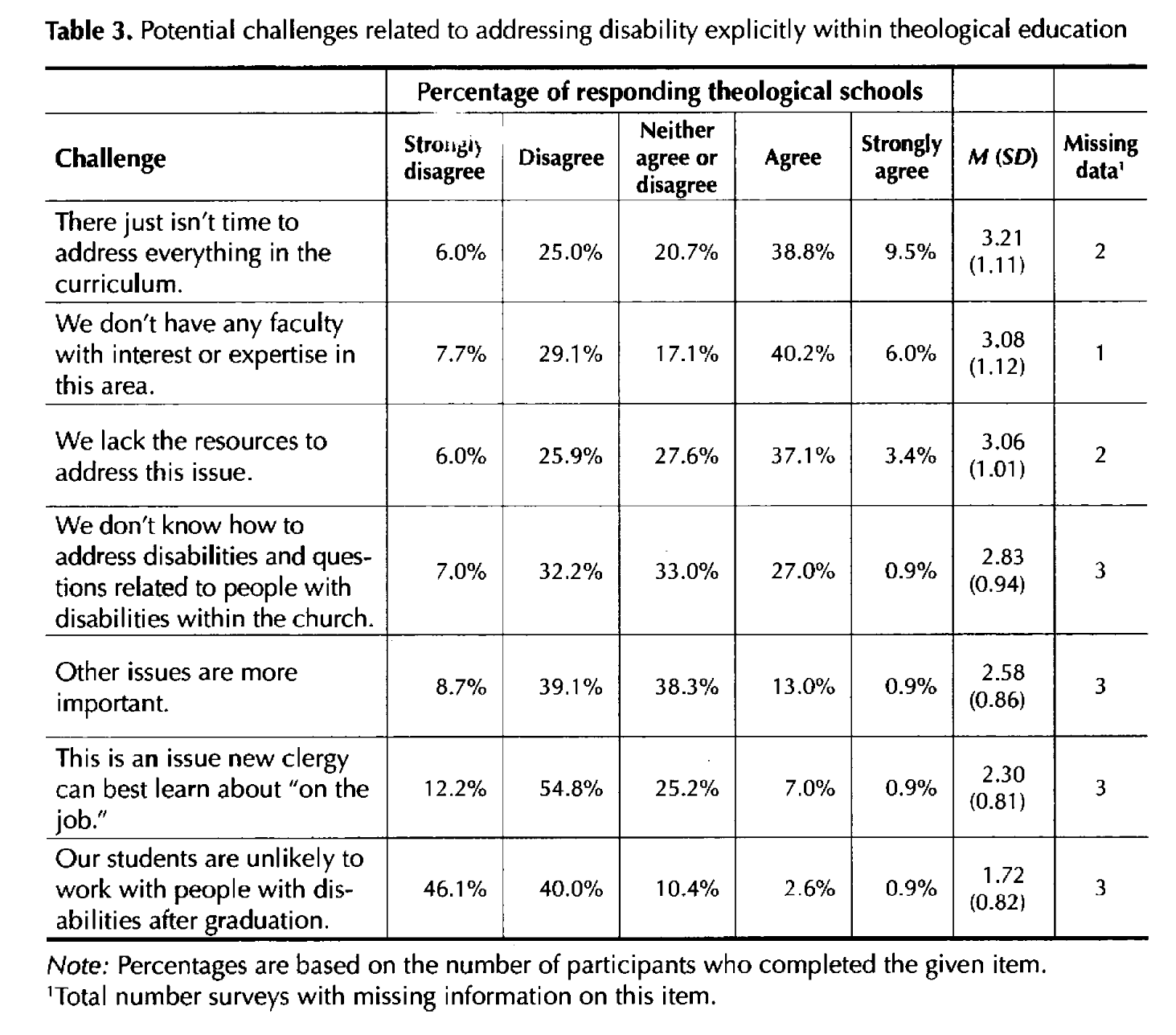
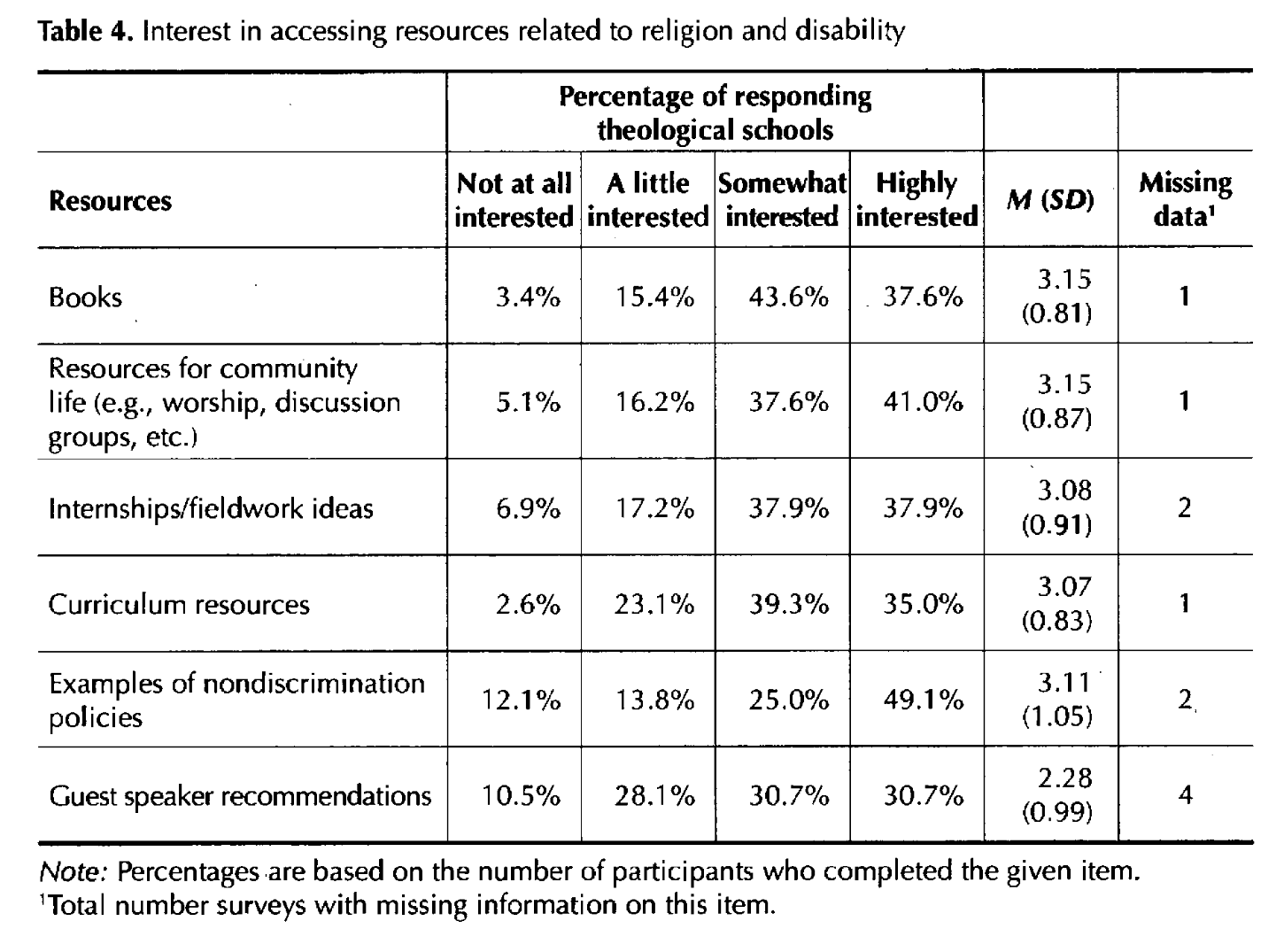
we identified several potential challenges associated with addressing disability in foe theological curriculum. Limited time, £aculty expertise, and available resources were all cited by school leaders as being among the most prominent barriers. In light o£ these findings, it was not surprising that many respondents also expressed high levels o£ interest in accessing books, community li£e resources, internship/fieldwork ideas, and speaker recommendations.
Pg.11
- Leaders at religious schools want to learn about disabilities, but I fear they don’t know how to start teaching about disabilities and ministry. We can do better. We must do better because they know better.
Quote
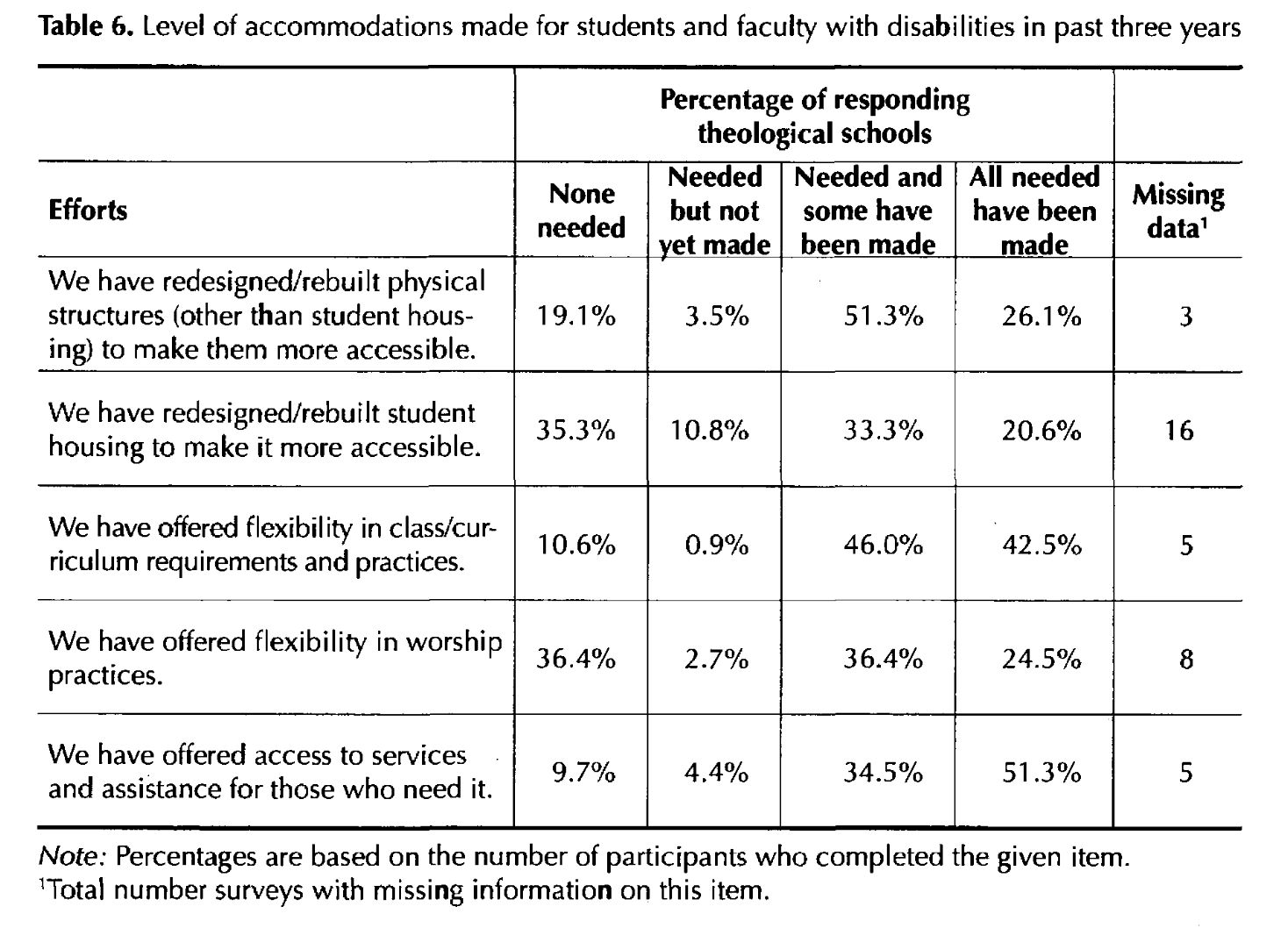
Theological schools in our sample varied widely in the degree to which they viewed themselves as having already made or not actually needing to make particular accommodations on their campuses. However, between one third and one half of respondents indicated that the following accommodations were needed, but they were not yet or only somewhat made: accessible buildings and student housing; flexibility in classroom, curricula, and/or worship practices; and access to needed services and assistance.
Pg.12
- Before we even teach about disabilities, we must ensure that schools are prepared to educate those with disabilities.
Quote
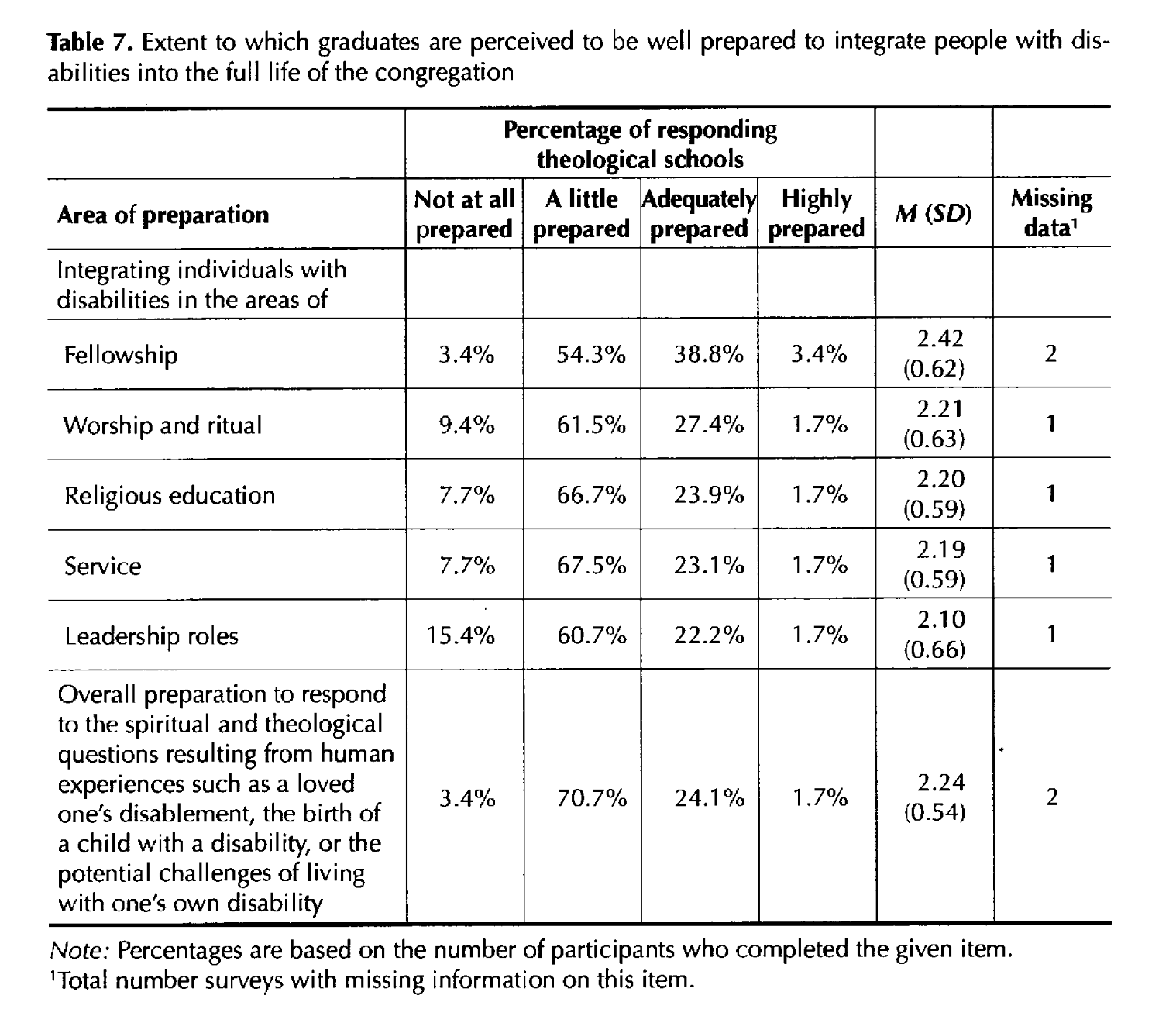
we found that most academic leaders felt that their graduates received little or no preparation that would help them to include people with disabilities into multiple dimensions of congregational life (i.e., fellowship, worship and ritual, religious education, service, and leadership) or to respond to spiritual questions resulting from disability experiences. Although people with disabilities are participating more fully in their wider communities,^ many clergy in North America are not leaving seminary well prepared to address the needs o£ a growing proportion o£ their congregation members.
Pg.12
- People with disabilities are already participating in all aspects of the church life. They want to participate. We are not preparing the leaders of our churches to be able to know how to do that.
 annandalenaomihDisabilityTheologicalEducation2014-14-x55-y222.png
Pg.14
*
 annandalenaomihDisabilityTheologicalEducation2014-15-x64-y370.png
Pg.15
*
 annandalenaomihDisabilityTheologicalEducation2014-16-x52-y332.png
Pg.16
*
 annandalenaomihDisabilityTheologicalEducation2014-16-x56-y55.png
Pg.16
*
 annandalenaomihDisabilityTheologicalEducation2014-17-x66-y447.png
Pg.17
*
 annandalenaomihDisabilityTheologicalEducation2014-17-x61-y170.png
Pg.17
*
 annandalenaomihDisabilityTheologicalEducation2014-18-x51-y332.png
Pg.18
*
Quote
9. Erik w. Carter, Including People with Disabilities in Faith Communities: A G uidefor Service Providers, Families, and Congregations (Baltimore, MD: Paul H. Brookes, 2007).
Pg.19
*
Quote
11. Craig Dykstra, “The Pastoral Imagination,” Initiatives in Religion 9, no. 1 (Spring 2001): 1 .
Pg.19
*
Quote
16. Robert c. Anderson, ed., Graduate Theological Education and the Human Experience ٠/ Disability, (Binghamton, NY: Haworth Press, 2003).
Pg.19
*
Quote
25. The n ew Collaborative on Disability, Religion, and Inclusive Spiritual Supports is now developing just such a resource.
Pg.20
*
Quote
28. Brock and Swinton, D isability in the Christian Tradition, 2012; Creamer, D isability and Christian Theology, 2010; Sally French, “Simulation Exercises in Disability Awareness Training: A Critique,” D isability & Society, 7, no. 3 (1992) 257-66, doi:10.1080/02674649266780261.
Pg.20
*